Leverage designed for years, not days
Appreciation needed by Jan 10, 2030
% to Index Target
latest value10,000
% to ETF Target
latest value1,000
Days remaining
The percentages show the appreciation the S&P 500 and the underlying ETFs would need to reach the 10,000 target by January 10, 2030. Illustrative - updated at launch.
The figures do not take into consideration the premium paid for purchasing the options. The cost of the options increases the percentage gains necessary for the Fund to produce positive returns.
XX is designed to provide the opportunity for substantial gains if the S&P 500 exceeds the Defined Target Index Level of 10,000 on the Defined Target Date of January 10, 2030. XX invests substantially all of its assets in long-dated call options referencing ETFs linked to the S&P 500 Index. XX is an actively-managed ETF.
The Fund’s investment strategy is different from other investment products, and the Fund may be unsuitable for some investors. It is important that investors understand the Fund’s investment strategy before making an investment in the Fund. An investment in the Fund is highly speculative and is suitable only for investors that are able to risk a complete loss of investment.
Long-Term Leverage - XX provides multi-year leveraged exposure to the S&P 500 by investing in a portfolio of long-dated call options.
No Daily Reset - XX avoids the volatility decay associated with leveraged ETFs that reset their exposure daily.
Access - XX provides access to custom FLexible EXchange® options (“FLEX Options”) that are generally unavailable to investors through traditional brokerage accounts.
| Ticker | XX |
|---|---|
| Primary Exchange | |
| Gross Expense Ratio | |
| Net Expense Ratio | |
| AUM | |
| Launch | 9/30/2026 |
| ETF Options | No |
|---|---|
| CUSIP | |
| ISIN | |
| Shares Outstanding | |
| Management Style | Active |
1Reflects fees incurred by the Fund before waivers and reimbursements, including but not limited to management fees, 12b-1 fees, and acquired fund fees and expenses.
2Net expenses reflect fees incurred by the Fund after waivers and reimbursements -- fee waivers for XX are contractual and in effect until at least May 1, 2027.
As of
| Name | Ticker | Weight |
|---|
| Name | Weight |
|---|
ETF holdings and allocations are subject to change at any time and should not be interpreted as an offer of these securities.
As of
| Closing Price | |
|---|---|
| Change ($) | |
| Change (%) | |
| 30-Day Median Bid/Ask Spread |
Annualized Performance
| 1 Year (as of ) | |
|---|---|
| 3 Year (as of ) | |
| 5 Year (as of ) | |
| Since Inception (as of ) |
| Net Asset Value | |
|---|---|
| Change ($) | |
| Change (%) | |
| 30-Day Median Bid/Ask Spread |
Annualized Performance
| 1 Year (as of ) | |
|---|---|
| 3 Year (as of ) | |
| 5 Year (as of ) | |
| Since Inception (as of ) |
The performance data quoted represents past performance. Past performance does not guarantee future results. Current performance may be lower or higher than the performance data quoted. The investment return and principal value of an investment will fluctuate so that an investor's shares, when sold or redeemed, may be worth more or less than their original cost. Returns less than one year are not annualized. For the most recent month-end performance, please call (855) 561-5728. You cannot invest directly in an index. Shares are bought and sold at market price (closing price), not net asset value (NAV), and are individually redeemed from the Fund. Market performance is determined using the Primary Exchange official closing price. Brokerage commissions will reduce returns.
What is XX?
XX is the Roundhill S&P 500® Target 10,000 2030 ETF. It is designed to provide the opportunity for substantial gains if the S&P 500 exceeds the Defined Target of 10,000 on the Defined Target Date of January 10, 2030. XX achieves its objective by investing substantially all of its assets in long-dated call options referencing ETFs linked to the S&P 500 Index.
How does the Fund work?
Rather than owning stocks, the Fund invests substantially all of its assets in long-dated call options, called LEAPS, tied to ETFs that track the S&P 500. Because these options can cost only a fraction of the market exposure they provide, the Fund may provide exposure to the S&P 500 that is a multiple of its net assets.
What are LEAPS?
LEAPS, or Long-Term Equity Anticipation Securities, are long-dated call options with expirations a year or more in the future. A call option gives the holder the right, but not the obligation, to buy the underlying at a set strike price. To learn more about LEAPS, please refer to our Blog.
What does the payout profile look like for a long call option?
A call option gives the holder the right, but not the obligation, to buy the underlying at a set strike price. Below the strike, the option expires worthless and the holder loses the premium paid; above the strike, its value at expiration rises point-for-point with the underlying. This payout profile is displayed below.
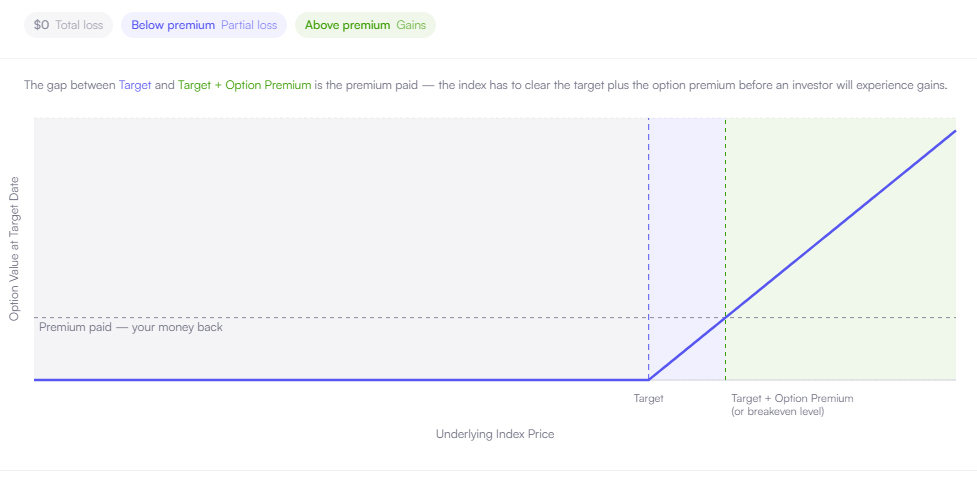
Illustrative payoff in index points. Below the strike/target the position loses the full premium. Above it, payoff rises with the index. Actual option costs and payoffs will differ.
The Fund utilizes LEAPS option contracts that reference one or more Underlying ETFs. To the extent there is a disconnect between the price of such ETFs and the value of the index, the Fund's option contracts may not produce the payout profile indicated above and the Fund could produce significant losses.
Is there a daily reset like leveraged ETFs?
No. The Fund's built-in leverage comes from owning long-dated options and has no daily reset, unlike daily-rebalanced leveraged ETFs. However, XX does experience theta decay, similarly to owning an option.
What happens on the Target Date?
One of three outcomes occurs. If the S&P 500 is at or below 10,000, the options expire worthless and investors should expect to lose all or substantially all of their investment. If the S&P 500 is above 10,000 but not by enough to cover the cost of the options, investors experience a partial loss. If the S&P 500 exceeds 10,000 by more than the cost of the options, the Fund's gains scale with every point above the target, with the potential to be substantial in an extreme outcome.
What is the most that I can lose as an investor?
Because the Fund wholly pays for its options exposure, its maximum loss is that premium or substantially all of the Fund's value. The Fund is not appropriate for investors who cannot bear the loss of their entire investment.
Is XX more volatile than the S&P 500?
Generally, yes. The Fund's value is driven by option pricing and can be far more volatile than the S&P 500 itself. Investors who buy or sell during the Defined Target Period may experience very different returns than those who hold to the Target Date.
Appreciation needed by Jan 10, 2030
% to Index Target
latest value10,000
% to ETF Target
latest value1,000
Days remaining1,260
The percentages show the appreciation the S&P 500 and the underlying ETFs would need to reach the 10,000 target by January 10, 2030. Illustrative - updated at launch.
The figures do not take into consideration the premium paid for purchasing the options. The cost of the options increases the percentage gains necessary for the Fund to produce positive returns.
as of TBD
as of TBD


 Phone:
  Email:


